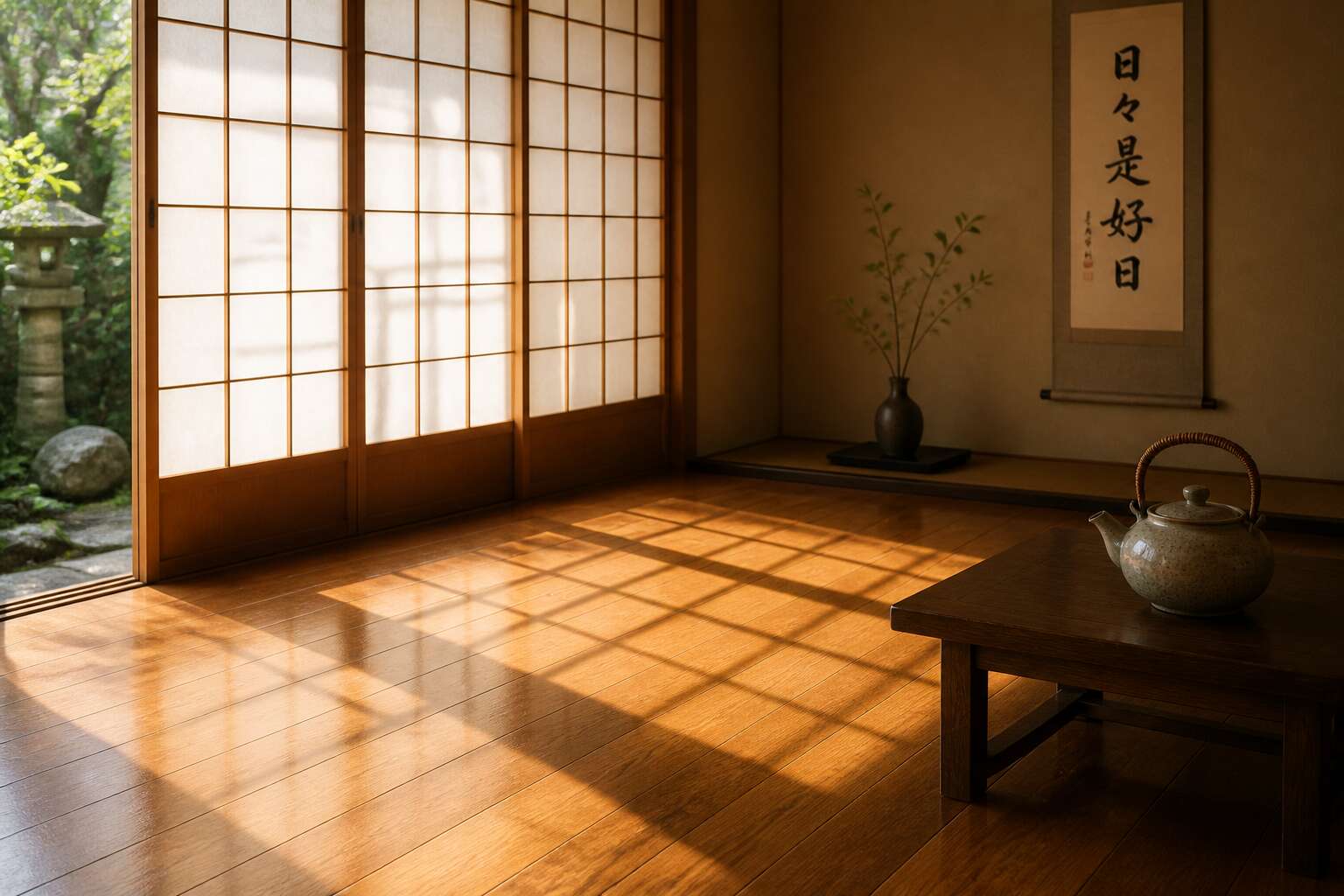
Historical Roots and Design Philosophy
The Influence of Wabi-Sabi on Interior Surfaces
The Japanese phrase “kintsugi” describes repairing broken pottery with gold, yet the same reverence for damage shapes their flooring. Wabi-sabi, a worldview centred on impermanence, prizes worn timber, visible grain, and the soft patina left by bare feet over generations. This philosophy transforms a wooden floor japanese from mere surface into a living record of time.
For South African homeowners, this approach challenges conventional expectations. We often seek flawless finishes, but the Japanese tradition embraces scars, knots, and colour shifts. These marks become the narrative! The floor does not hide its age; it announces it.
- Asymmetry in plank layout
- Natural oils instead of glossy lacquer
- Soft, matte textures that respond to touch
Wabi-sabi also influences how surfaces interact with light. A wooden floor japanese in this style absorbs rather than reflects, creating a subdued atmosphere that feels grounded. This is not about neglect; it is about acceptance.
Natural Material Harmony and Minimalist Aesthetics
The oldest wooden buildings on Earth stand in Japan, and their floorboards have survived twelve centuries. This longevity comes from a design philosophy that treats the floor as a functional layer, not a decorative finish. Early shrines raised a wooden floor japanese above damp soil to protect grain, leading to advanced joinery. Craftsmen developed joints that allowed planks to expand and contract with humidity.
Material selection follows the same logic. Builders preferred specific domestic woods:
- Hinoki for straight grain
- Cedar for insect resistance
- Zelkova for dimensional stability
They planed the grain, never sanded, and joined boards with dovetails and laps. These joints absorbed seasonal movement. The result supports minimal aesthetics. In a traditional room, the wooden floor japanese covers a vast, uncluttered area. It anchors the space without dominating. This empty expanse, called ma, directs attention to light and texture.
Spatial Openness and the Role of Floor Levels
The raised wooden floor japanese transformed how inhabitants relate to the ground. Stepping up into a room is a deliberate act. It signals a shift from the messy outdoors to the ordered interior. This single step, common in minka and shōin styles, creates spatial openness without erecting walls.
Floor levels carry meaning. In traditional homes, the entry threshold, the engawa, and the tatami platform each represent a gradient of intimacy.
- The earth floor, or doma, handles daily chores.
- The engawa acts as a semi-outdoor corridor.
- The raised interior floor hosts formal activities.
The wooden floor japanese anchors this hierarchy. Visible grain and smooth planks show that elevation is not decoration. It is structure. I have stood on such floors, and the difference is immediate. A house that raises its floor demands a slower pace. You do not barge in. You step up, and the posture changes!
Materials and Finishing Techniques
Hinoki and Cedar: Preferred Softwoods for Warmth and Fragrance
Hinoki has been used in Japanese temples for over a millennium. Its natural oils resist moisture and decay. Cedar offers similar durability with a lighter, more aromatic profile. Both are softwoods, so they dent easily. That is part of their appeal. They soften footfall and keep rooms warm in winter.
Finishing techniques matter. Traditional methods rely on oil and wax rather than synthetic lacquers. This lets the wood breathe and release its fragrance.
- Oil deepens the colour of the timber.
- It highlights the straight grain of hinoki.
- It allows periodic reapplication without sanding.
For a wooden floor japanese style, this finish suits the material. The scent fades over time but returns with humidity. That is the character of these woods!
Joist and Board Orientation Patterns for Structural Integrity
A 40.5 centimeter gap separates each joist in a wooden floor japanese. This number matches the tatami mat, a module used for centuries. That is no coincidence! Board orientation follows the same logic. Planks run perpendicular to the joists, with staggered end joints to distribute load.
Each seam is offset by at least two rows. No two weak points align. The floor behaves as one interlocking unit.
- Quarter sawn boards resist cupping
- End grain left open for expansion
Traditional joinery locks pieces without nails, letting the timber breathe with humidity. A ventilated crawl space beneath pulls moisture away and completes the structure.
Oil vs. Lacquer Finishes: Sheen, Protection, and Texture
Among Cape Town homeowners, the choice between oil and lacquer for a wooden floor japanese often mirrors a preference for quiet over statement. Oil finishes penetrate the timber, leaving a dry, tactile surface that warms with age. Lacquer seals the top with a glassy layer, offering resilience against spills and heel marks. The texture tells the story: oil invites walking barefoot, lacquer suits formal dining rooms.
- Oil: low sheen, breathable, simple to refresh
- Lacquer: high gloss, impermeable, longer lasting
Japanese joinery leaves end grain exposed, so the finish must respect seasonal movement. Oil allows the wood to expand and contract without cracking, while lacquer demands a stable environment. For a home near the coast, humidity swings make oil the more forgiving companion.
Underfloor Ventilation and Moisture Management Systems
Every wooden floor Japanese design depends on the crawl space. Underfloor ventilation is unglamorous, but it prevents prized hinoki from becoming waterlogged. In Cape Town’s wet winters, moisture creeps through the soil and rises, carrying salts and fungi. A well-designed subfloor system keeps the air moving, so timber stays dry and stable. Cross-flow ventilation, using low and high vents, creates a natural chimney effect. I have seen too many homeowners skip this step and later face cupped boards.
A few essentials make the difference:
- Ground moisture barriers, the plastic sheet that blocks rising damp
- Vent openings sized to the floor area, not guesswork
- Breathable insulation that does not trap humidity
These components work with the wooden floor Japanese joinery, allowing seasonal movement without cracking. Proper drainage around the foundation keeps rainwater away, while air gaps under the joists permit evaporation. It is a humble system, but it outlasts any finish.
Tatami Alternatives and Their Integration with Timber
Modern homes in Cape Town often skip tatami because it demands constant care. Instead, I reach for woven rush tiles or flax fibre mats. These tatami alternatives offer the same forgiving underfoot feel without the humidity problem. Their edges can be trimmed to negotiate timber expansion gaps, so they sit flush against wooden floor japanese joinery. For a more permanent option, consider cork planks fused with a dark timber border. Cork breathes, it deadens sound, and it does not trap dust. The integration feels seamless. We tested a blend of rush panels and solid oak in a Bergrivier cottage, and the contrast gave the room a quiet rhythm. This approach respects the floor’s structural role while adding warmth. A list helps when choosing:
- Check the backing material for mildew resistance
- Match the weave direction to the room’s sightline
- Leave a 10mm gap around the perimeter for movement
Installation and Maintenance Essentials
Subfloor Preparation and Acclimation of Planks
Nearly 70 percent of wood floor callbacks stem from moisture issues in the subfloor. A Japanese carpenter once said that the floor’s life begins beneath the boards. Preparation is everything.
For a wooden floor japanese, the concrete slab needs a moisture test first. A calcium chloride kit gives the most reliable reading. Wooden subfloors require checking for dips. Use a straightedge and shim strips to mark any low or high sections. Sand down the high spots, fill the low ones with leveling compound.
Acclimation deserves equal attention. Stack the planks in the room where they will be laid. Leave spacers between layers so air circulates. Allow seven to fourteen days, depending on the local climate. The moisture content of the boards should land within two percent of the subfloor’s reading.
Check these conditions before fitting:
- Room temperature above 18 degrees Celsius
- Relative humidity between 40 and 60 percent
When the base is right, a wooden floor japanese stays stable for decades.
Traditional Joinery Methods Without Metal Fasteners
A single wooden floor japanese can contain over a hundred interlocking joints, yet not one metal fastener. The craft relies on shiguchi, the ancient art of joining timber with precision cuts alone. Carpenters cut mortise and tenon joints with hand-chiseled accuracy, allowing seasonal movement without squeaking or splitting.
The tolerance is exact. A shachi-seni dovetail locks boards against uplift while permitting natural expansion. Metal fasteners would shear under these stresses; the wood itself absorbs them.
Maintenance honors that precision. For a wooden floor japanese, daily care means a barely damp cloth, never a soaked mop. I have seen floors fail in a decade when owners reached for steam cleaners! When surfaces dull, revive them with a thin wipe of solvent-free oil, reapplied along the grain.
- Spill wiping done immediately to prevent edge swelling
- Furniture lifted, never dragged across the grain
- Humidity held between 40 and 60 percent year-round
Daily Cleaning and Polishing Rituals
Installing a wooden floor japanese demands patience, but the real test begins the following morning. I have watched homeowners undo months of careful acclimation with a single aggressive scrub. The wood prefers routine, not reaction.
Daily cleaning starts with a soft broom or vacuum on the bare floor setting. Never leave grit overnight. For the weekly wipe, a damp microfiber cloth, wrung until barely moist, moves along the grain.
- Wipe spills within minutes to prevent edge swelling
- Dilute pH-neutral soap in water, never pour directly
- Dry the surface immediately with a clean cloth
Polishing a wooden floor japanese is a quiet ritual. Twice a year, apply a thin layer of natural oil with a soft cloth, working in sections. Let it absorb for twenty minutes, then buff with a dry cloth. The surface turns softer, warmer, the grain slightly luminous. That is when the floor reveals its character!
Humidity Control to Prevent Gapping and Cupping
In Johannesburg, the dry winter air pulls moisture from your wooden floor japanese. Gaps appear overnight. Then summer humidity swells the boards until they cup. The wood is not being dramatic. It is responding to the environment.
Humidity control determines whether a floor lasts decades or needs replacement. Keep the relative humidity between 40 and 60 percent. Use a hygrometer. If your home drops below 35 percent, run a humidifier. Above 65 percent, ventilate or dehumidify.
Watch for these warning signs:
- Fine cracks along the grain indicate dry air.
- A slight ridge between boards signals swelling.
- Cupping across the width points to moisture from below.
Chronic humidity neglect ruins a wooden floor japanese. The wood forgives an occasional mistake, but persistent carelessness leaves permanent damage.
Scratch, Dent, and Stain Repair Approaches
During installation, a wooden floor japanese develops its stability only after the planks adjust to the room’s climate. Scratches appear as fine lines, dents as shallow depressions.
For scratches, rub in a tinted oil that matches the grain. For dents, hold a damp cloth over the spot and apply a hot iron; the steam lifts the fibres. Sand the area gently, then seal it. Stains, such as wine or ink, require mineral spirit on a soft cloth, working inward from the edges to avoid spreading.
- Test every repair method on an unseen section first.
- Work with the grain, never against it.
- Reapply the original finish after any repair.
Each treatment leaves a trace. A wooden floor japanese keeps those traces and remains solid.
Longevity Planning: Refinishing and Partial Replacement
A wooden floor japanese does not ask for much, but it asks for time. Refinishing returns a surface to its original darkness, erasing years of footfall. Every decade or so, the top layer must be sacrificed to save the rest.
Partial replacement is different. When one board rots or warps, you cut it out and slot in a new piece. The surrounding planks barely notice. I have seen this done in a single afternoon, and the floor outlived the house around it!
- Refinishing removes the top layer only.
- Partial replacement targets a single board.
- Both extend the life of the floor.
The floor holds its memory. Refinishing does not erase that; it deepens it.
Contemporary Applications and Interior Styling
Blending Timeless Timber with Modern Minimalist Interiors
Interior designers in Johannesburg and Cape Town are reinterpreting the wooden floor japanese aesthetic for open plan living. This is not a nostalgic revival; it is a considered response to the emptiness of modern architecture. A pale oak surface creates a quiet foundation for sculptural furniture, while sliding shoji screens diffuse harsh African light.
The effect depends on restraint. Choose low profile sofas and ceramic vessels. Let the grain remain visible, and pair timber with limewash plaster or linen. Consider these principles:
– Allow a single statement piece, like a black steel bookshelf, to anchor the space
– Keep window treatments minimal to preserve the visual weight of the flooring
– Use directional boards to guide movement between zones
In this context, a wooden floor japanese is the unifying element, holding disparate features in steady balance.
Radiant Heating Compatibility and Comfort Considerations
Radiant heating changes how a wooden floor japanese responds in a Johannesburg winter. Warmth rises from below, and the timber must move with it. Oak behaves well. Cedar less so. The real issue is thermal conductivity. A thin plank warms faster than a thick one, but thick boards offer stability.
I have seen floors fail when installers ignore the expansion gap. Radiant heat accelerates moisture loss. The timber dries, shrinks, and gaps appear. Keep the humidity between forty and sixty percent!
Successful installations share a few traits:
- Quarter sawn boards for dimensional stability
- A stable species like white oak
- Board widths under 180 millimetres
The surface temperature matters too. Keep it below twenty seven degrees Celsius. Your feet feel the warmth, but the fibre structure stays intact.
Color Palettes, Natural Lighting, and Perceived Room Depth
In a Johannesburg home, the wooden floor japanese becomes the surface that ties a room together. Pale ash or white oak boards reflect the highveld sun, making a modest space feel larger. Deeper tones, like smoked oak, absorb light and create a quieter mood. The palette around the timber matters as much as the grain itself.
- Warm neutrals like sand and oatmeal
- Muted greens that echo the garden
- Charcoal accents for contrast
Natural light shifts across the boards throughout the day. A wooden floor japanese with a matte finish scatters light instead of bouncing it harshly. That soft diffusion adds perceived room depth without any structural change. The grain pattern draws the eye along the longer axis of the room, which makes narrow spaces feel more generous.
Furniture Pairing and Rug Placement for Visual Balance
In a Johannesburg loft, the wooden floor japanese anchors a seating arrangement without competing with it. A low-profile sofa in oat linen lets the timber grain stay visible. Pairing heavier pieces, like an oak coffee table, with lighter chairs keeps the surface balanced.
Rug placement matters more than size. Leave a border of exposed boards around the rug to frame the space. For dining areas, choose a flat-weave rug that slides easily under chair legs. In open-plan rooms, use a single rug to tie two seating zones together. Honestly, that gap of timber does the quiet work!

0 Comments