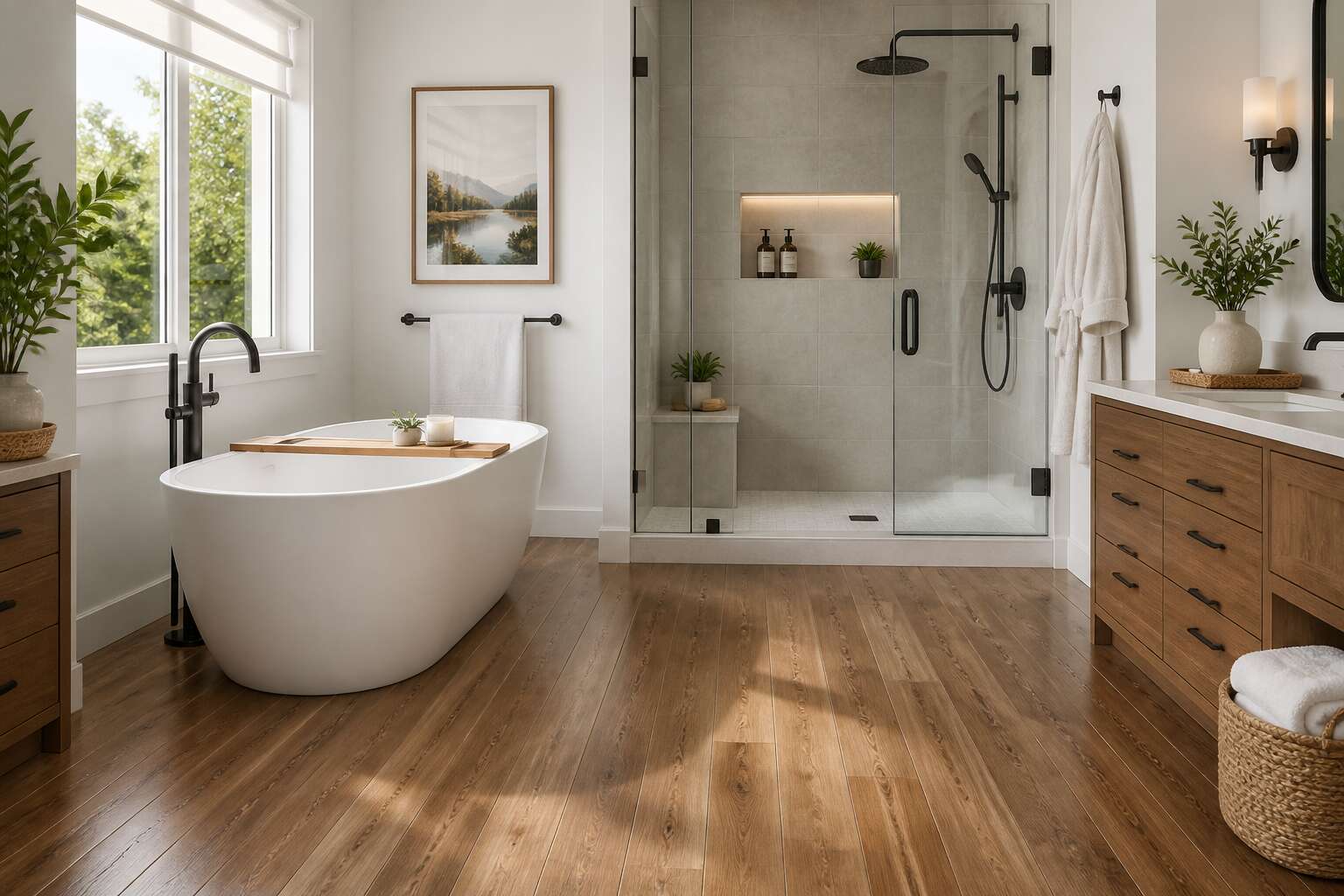
Why Wood Flooring Works in Bathrooms
The Aesthetic Appeal of Natural Wood
There is a moment of quiet rebellion in every decision to install wooden floors for bathrooms. We are so conditioned to think of water as the enemy of timber that we forget the centuries-old Dutch and Danish practice of oiled hardwood in wet areas. The aesthetic payoff is a distinctive warmth that is impossible to replicate with porcelain or stone. A real wood surface introduces a natural grain and texture that turns a purely utilitarian room into a sanctuary. The visual softness of the planks provides a profound juxtaposition to the typical coldness of tile.
Consider the sensory experience rather than just the logistics. The subtle give underfoot and the matte finish of a quality engineered board offers a tactile richness that changes how you enter the space. The wood does not pretend to be stone; it owns what it is, which is why the design works so well.
Here are a few ways the natural material elevates the décor without compromising durability:
– The variation in grain pattern adds depth, preventing the floor from looking flat or sterile.
– The warm undertones complement both brass fixtures and matte black fittings.
– The surface develops a beautiful patina over time, telling a story unique to your home.
When you choose wooden floors for bathrooms, you are not just picking a surface. You are deciding that the heart of your home should feel less like a showroom and more like a living space. The look is softer, more organic, and undeniably inviting.
Modern Waterproof Wood Options
A 2023 survey by the South African Institute of Architects found that 38% of homeowners now specify wooden floors for bathrooms. The reason is not nostalgia but chemistry. Modern waterproof wood options use cross laminated cores and polymer sealed surfaces that repel water at a molecular level.
Why do these floors work? I have watched steam rise off a shower and settle on an engineered oak plank without causing a ripple. The secret is in the layers, a profound change in how we treat water!
- Cross laminated construction prevents bowing.
- Hydrophobic finishes stop moisture penetration.
- Acclimatised boards tolerate temperature shifts.
These features mean wooden floors for bathrooms can outlast carpet. The maintenance is simple and the performance is measurable. For South African homes, with their humid coastal summers and dry Highveld winters, the material adapts.
Adding Value to Your Home
Few improvements recapture their cost as reliably as timber underfoot in a wet room. I have watched buyers remove a shoe and press a bare foot against the wood. The bathroom often decides the sale in South Africa.
The perceived value of wooden floors for bathrooms rests on performance under duress. Buyers understand wooden floors for bathrooms are no longer a compromise. They are an upgrade! This choice signals a homeowner who invested in materials that endure moisture, heat, and daily use. That impression lingers.
Prospective buyers notice:
- The acoustic softness after a tiled passage.
- The tactile warmth on a bare foot at 6 a.m.
- The absence of grout lines that stain and age.
These details convert into perceived construction quality. Ask any estate agent. The difference between a property that lingers and one that attracts offers often comes down to these quiet choices.
Choosing the Right Wood Type
Solid vs. Engineered Wood
Bathrooms are wet. Solid wood and water have a historically adversarial relationship. Yet, homeowners still crave the warmth of timber underfoot. The secret lies in the construction. Solid planks, typically 19mm thick, are a single cut of timber. They respond to every humidity spike by expanding or warping. This makes them a risky wager for a room that sees daily steam bursts. Engineered planks feature a stable plywood base topped with a real wood veneer. That cross-ply construction resists the moisture curse. For a bathroom, engineered wooden floors for bathrooms deliver the look without the tantrums. Consider the practical differences:
– Solid wood: Cannot withstand wet conditions, temporary or permanent.
– Engineered wood: Handles humidity and small spills with minimal fuss.
– Solid wood: Requires sanding and resealing every few years.
– Engineered wood: Offers a durable finish, ready for installation.
The concern is never the wood itself, for every wooden floor is vulnerable. It is the substrate and the adhesive that save the day. The thick veneer on quality engineered planks means you can refinish them, though perhaps only once or twice. That is a fair trade for a floor that stands firm against a dribbling tap or a clumsy shower user. Forget the myth of marine grade timber; sticks are sticks. For a room where tiles feel cold, wooden floors for bathrooms offer a logical compromise. Longevity depends on the wear layer, not the species name on the box. Choose the engineered option, keep the rooms ventilated, and your floor will outlast the grout.
Top Water-Resistant Species
Teak’s oleoresins resist water with quiet persistence. Iroko follows, its interlocked grain resisting mildew and decay. For a bathroom, the species is a primary safeguard, not an afterthought. I once specified oak and watched it warp within months.
Consider these water-resistant veterans:
- Teak, oily and unyielding, available from temperate sources
- Iroko, dense enough to resist dents and moisture alike
- Merbau, with its rugged texture and natural preservatives
These timbers form the best wooden floors for bathrooms when paired with a thick wear layer. The veneer, not the name, determines survival. A deep cut reveals fresh grain beneath; a shallow one exposes the plywood heart. Choose accordingly, and the steam will not penetrate.
Finishes That Seal Out Moisture
The finish determines survival. No species lasts in a bathroom without a sealant that withstands constant humidity. I have watched teak fail when coated with the wrong varnish, and the lesson stuck.
Consider these moisture barriers:
- Penetrating oils that bond with the grain
- Polyurethane layers that flex with temperature shifts
- Ceramic-infused coatings that resist abrasion
Each finish behaves differently under South African humidity, so test before you commit! A single thin coat offers little resistance. Two or three layers, properly cured, change the dynamic entirely. The finish must be reapplied on a schedule, not when visible wear appears. Wooden floors for bathrooms demand this discipline. The alternative is slow, silent degradation that reveals itself only when the damage is complete.
Understanding Hardness and Durability
A wood species can score high on the Janka hardness scale and still fail in a bathroom. The reason lies in how density interacts with moisture movement. Dense fibres resist dents, but they also swell unevenly when humidity spikes. I have seen oak with a perfect rating warp because the growth rings were not stable enough.
When you evaluate a plank, look beyond the hardness number. Consider these markers:
- Indentation resistance under constant foot traffic
- Expansion coefficient across temperature shifts
- Compression strength at the edges and joints
These properties separate a floor that ages gracefully from one that cracks silently. The right wooden floors for bathrooms pair high hardness with low moisture absorption. That combination requires examining the cut, the grain direction, and the kiln drying process. Nothing else predicts durability with any accuracy.
Essential Installation Guidelines
Preparing the Subfloor
Moisture is the main enemy of a subfloor, and in South Africa, humidity is a constant factor. Before installing wooden floors for bathrooms, you need to verify the state of the concrete or plywood base. A quick visual check is not enough.
The subfloor must be level, clean, and dry. I have seen installations ruined because a bump or a hollow spot was ignored. Use this order of operations:
- Test moisture with a hygrometer and a calcium chloride kit.
- Grind down high spots and fill low ones with a leveling compound.
- Sand the entire surface to create a mechanical bond for the adhesive.
Neglect these steps and you invite warping. Prepare properly, and the final result will remain flat and stable for years. The work is not glamorous, but it is the only difference between a reliable floor and a costly failure.
Acclimating the Boards
Wood responds to its surroundings. In a bathroom, that means moisture and temperature. Before any adhesive meets the subfloor, the boards need time to adjust. A week is a reasonable minimum. In South Africa, where humidity swings between coastal mist and Highveld dryness, acclimation is essential.
Store the planks in the room where they will be installed, stacked with spacers between rows. Keep the packaging open. Control the climate to approximate the final condition:
- Set the thermostat to a typical bathroom temperature.
- Run a dehumidifier if the air feels heavy.
Measure moisture content with a meter every couple of days. When readings stabilise, the timber is ready. Wooden floors for bathrooms demand this patience. Skip it, and you will hear the consequences in the form of creaks and gaps.
Hiring a Professional vs. DIY
Few moments in a renovation are as unforgiving as installation. A single misplaced plank can betray everything that came before. For wooden floors for bathrooms, the margin for error narrows further because moisture will find any weakness.
Hiring a professional in South Africa often means someone who has battled coastal humidity and Highveld dryness. They arrive with the correct tools and the patience to handle expansion gaps. The cost buys certainty.
DIY suits those who know their own limits. Modern click-lock systems are forgiving, but waterproofing membranes and transitions are not. Ask yourself honestly:
- Have you installed flooring before?
- Do you own a moisture meter and proper cutting tools?
- Can you handle the physical demands of kneeling and lifting?
If any answer is no, the professional route is the wiser investment. The choice ultimately shapes how long your wooden floors for bathrooms will last, and I have seen both outcomes.
Underfloor Heating Compatibility
A warm floor under your feet on a Johannesburg winter morning is a quiet luxury. But radiant heat and wooden floors for bathrooms share a delicate relationship. The wood’s hygroscopic behavior means it releases moisture when heated. Underfloor heating forces that exchange to happen quickly, often faster than the timber can handle.
Most manufacturers cap surface temperature at 27 degrees Celsius. Beyond that, finishes soften and cores shrink unevenly. In my experience, most failures trace back to overheating. A simple rule governs the process:
- Choose engineered planks with a wear layer under 4mm.
- Keep system water below 45 degrees Celsius.
- Ramp up heating gradually over several days.
Expansion gaps must be wider, since heated subfloors push boards outward with real force. South African suppliers often pair wooden floors for bathrooms with electric mats instead of wet systems. Electric mats respond faster to the Highveld’s sharp temperature swings, and that speed makes all the difference!
Choosing the Right Adhesive
Adhesive choice determines whether your wooden floors for bathrooms endure the Highveld’s humidity cycles or fail within a season. Standard PVA glues swell when moisture penetrates the subfloor. Polyurethane adhesives bond differently. They cure through a chemical reaction rather than drying, creating an elastic bond that permits slight timber movement without breaking.
Consider these factors when selecting adhesive:
- The slab’s moisture vapour transmission rate, measured before application
- Board width and its seasonal expansion coefficient
- Subfloor type, whether screed or existing tile
Two-part polyurethane adhesives suit wider boards, though they demand immediate cleanup during installation. Moisture-cured silane hybrids offer a slower working window. Both outperform cementitious patches that crack once the timber breathes. Always verify the adhesive’s compatibility with your installed heating system before committing.
Maintenance and Longevity Tips
Daily Cleaning Routines
The daily ritual of caring for wooden floors for bathrooms is a discipline against moisture. I recommend sweeping with a soft brush each morning, lifting the grit that accumulates underfoot. A barely damp microfiber mop, wrung until it yields no water, handles the residue of steam and splashes.
- Use only pH-neutral cleaners, never vinegar or bleach
- Dry standing water immediately with a soft cloth
- Place absorbent mats at every entry point
South African humidity demands vigilance. The wood rewards those who respect its limits. I have seen floors survive decades when owners treat them like cherished relics rather than mere surfaces.
Preventing Water Damage
Prevention outranks remedy when you live with wooden floors for bathrooms. I inspect the finish every quarter, running a hand over the surface to feel for dull patches that signal moisture intrusion. A simple trick: place a drop of water on the floor. If it beads, the seal holds. If it soaks in, the finish needs attention before water finds the wood beneath.
South African summers bring high humidity, so I maintain a routine of airing the room after hot showers. The biggest threat comes from slow leaks under the vanity, where water pools unseen for weeks. A monthly check of supply lines and drain fittings prevents this quiet decay.
The following practices keep those floors resilient:
- Place a silicone mat under the basin to catch drips
- Reapply a protective coat when the water test no longer beads
- Ventilate the bathroom for ten minutes after bathing
Mindful habits, not expensive products, ensure these floors outlive the trends that brought them here.
Refinishing and Resealing
Refinishing is a matter of timing. The sheen fades, water stops beading, and wooden floors for bathrooms demand attention. A light sanding every few years removes surface wear without sacrificing the wood’s character. The resealing process takes a weekend, but the payoff lasts much longer. I prefer a water-based polyurethane for its low odour and quick cure in our humid climate. Oil-based finishes offer depth, though they demand patience. A friend once skipped the sanding step, and the new coat peeled within months. That mistake taught me more than any manual could. Resealing wooden floors for bathrooms keeps the surface intact long after trends have moved on. I schedule the work in autumn, when the air is dry and the windows stay open. The ritual rewards careful observation, and the floor responds with years of quiet service!
Dealing with Humidity Fluctuations
Humidity in South Africa shifts with the seasons, and wooden floors for bathrooms feel every change. A coastal summer brings moisture that swells boards, while a dry Highveld winter shrinks them to narrow gaps. The longevity of wooden floors for bathrooms depends on your willingness to observe these movements.
I keep a hygrometer in the bathroom, not as a decoration but as a diagnostic tool. When readings climb past sixty percent, I open the window and run the extractor fan. During dry months, a small humidifier stabilises the air. The goal is a steady equilibrium, around fifty percent, where the wood rests.
This vigilance sounds obsessive, but the alternative is cupping and cracking. Once you accept that humidity directly affects your floor, maintenance becomes instinct. The response must come before the wood shows stress. That response is the true art of longevity.
Common Concerns and Solutions
Addressing Moisture Issues
Moisture remains the central concern for any timber surface in a bathroom. Before installation, a vapour barrier and proper subfloor preparation block capillary rise from the concrete slab. After installation, the vulnerable points are the joints and the perimeter, where water can seep under the boards.
An extractor fan running during and after a shower removes airborne moisture before it settles. A thin layer of protective wax at the seams every few months reinforces the factory finish. For wooden floors for bathrooms, the most reliable practice is to dry visible water immediately with a cloth.
Common moisture sources to monitor:
– Splash from the basin and bath
– Condensation on walls and exposed pipes
– Leaks from the toilet flange
Each source requires a specific countermeasure, from silicone at the skirting to periodic checks of the plumbing. A simple moisture meter can reveal hidden damp before it distorts the boards. None of these steps are elaborate, but they keep the timber stable for years.
Warranties and Insurance
In South Africa, the warranty on wooden floors for bathrooms is a document most homeowners never read until a claim gets denied. The exclusions hide in the clauses. Moisture damage from a slow leak is often excluded from standard insurance, while a sudden pipe burst usually qualifies for cover.
Manufacturers void warranties if the installer skipped the substrate moisture test. I have seen claims denied for a missing certificate alone. Keep the installation certificate, the finish details, and dated photographs. Insurance assessors demand proof of maintenance.
- Confirm whether your policy covers gradual damp or only sudden water events.
- Check if the floor brand requires specific sealants or approved installers.
One logged moisture reading every month costs little and could save a claim. That record proves the timber stayed stable.
Alternatives to Real Wood
Homeowners often worry that wooden floors for bathrooms will warp or swell at the first splash. These fears are understandable, modern installation methods and robust finishes now address many concerns. Yet if you want the look of timber without the temperament, several alternatives deliver convincing results.
- Porcelain tile with wood grain textures offers high water resistanceand scratch protection.
- Luxury vinyl planks mimic natural grainand feel soft under foot while containing moisture.
- Laminatewith sealed edges provides an affordable option, though it tolerates less standing water than tileor vinyl.
Each alternative has its own trade-offs. Porcelain feels cold unless paired with underfloor heating; vinyl can dent under heavy appliances. If your priority is long-term durability in abathroom, consider these materials carefully. For others, wooden floors for bathrooms remain worth the extra care.
Replacing Damaged Boards
Accidents happen. Many homeowners assume that a single water stain or a swollen seam means the end of their wooden floors for bathrooms. That fear is often more dramatic than the reality. Modern floating floors and glued systems are designed with repairability in mind. Individual planks can be unclicked and swapped, or carefully cut out and replaced without dismantling the entire room.
The key is to identify the problem early. A board that has buckled may settle back down once the source of moisture is removed and the area dries out. Other issues require more decisive action.
– Persistent warping that does not flatten after drying
– Visible mould or rot beneath the surface
– Deep scratches or dents that refinishing cannot erase
Many homeowners ask if a single damaged board can be replaced. The answer is yes, provided you have kept spare planks from the original installation. This is why it is wise to store a few extras in a dry, cool place. The repair process itself is straightforward for a professional, and even a confident DIYer can manage it with the right tools. The satisfaction of restoring the floor’s smooth surface is its own reward. Wooden floors for bathrooms can handle life’s little accidents when you know how to respond. The quiet triumph of a seamless repair makes the maintenance worthwhile.
Environmental Impact and Sustainability
Every plank carries a quiet history of forest, rain, and sunlight. Choosing wooden floors for bathrooms means entering into a relationship with a renewable material. Sustainably harvested timber, certified by programmes like the Forest Stewardship Council, offers traceability from forest to showroom. The carbon stored within the wood remains locked in your home rather than returning to the atmosphere. This makes wooden floors for bathrooms a meaningful choice for homeowners who weigh their footprint.
The environmental concerns around wooden floors for bathrooms often centre on finishes and adhesives. Waterproofing systems have evolved, with low VOC options that protect both the wood and indoor air quality. Some manufacturers now offer natural oil based seals that breathe with the grain. Consider the full lifecycle:
– A solid wood floor can endure for decades and be sanded multiple times.
– Engineered boards use less timber per square metre while delivering stability.
– At end of life, both types can be repurposed, recycled, or returned to biomass.
Wooden floors for bathrooms, chosen with care, compare favourably to synthetic alternatives in embodied energy and long term environmental impact. The resource renews itself. The floor outlasts trends.

0 Comments